
Search is changing fast. For years, brands focused on rankings, clicks, backlinks, and website traffic. Now, more discovery is happening inside AI-generated answers on platforms like Google AI Overviews, ChatGPT, and Perplexity. That shift has created a new challenge for marketers: how do you measure visibility when users may get the answer without ever clicking through to a website?
That is where the Ziptie AI Search Performance Tool comes in.
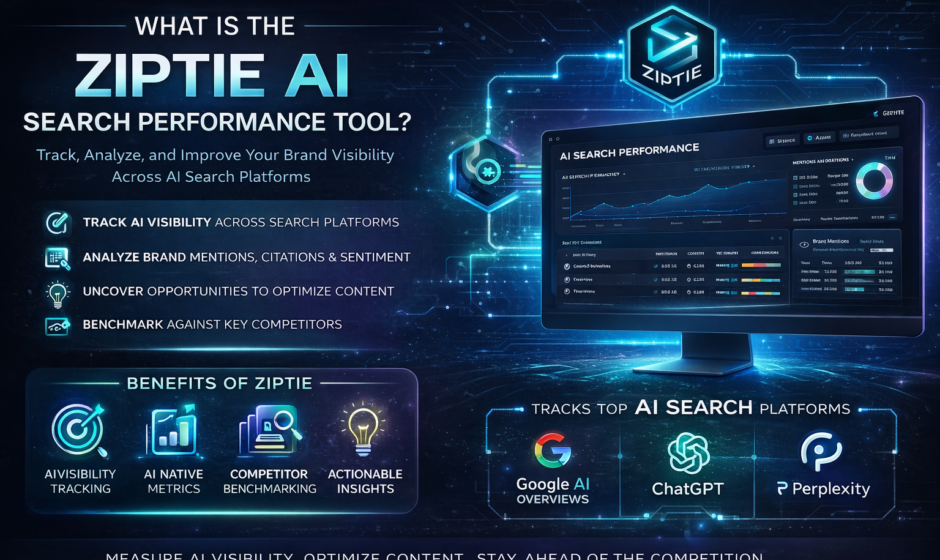
Ziptie is an AI search visibility and monitoring platform built to help brands understand how they appear inside AI-generated search experiences. According to Ziptie’s official site, the platform helps users track visibility across Google AI Overviews, ChatGPT, and Perplexity, then use that data to improve online presence. It also positions itself around three core areas: AI Search Monitoring, Content Optimization, and Insights & Recommendations.
In simple terms, Ziptie is not a classic SEO rank tracker. It is a tool for brands that want to know whether AI systems are mentioning them, citing their content, representing them positively, and showing competitors instead. Ziptie’s own materials say it tracks metrics such as brand mentions, sentiment analysis, citation tracking, competitive benchmarking, AI Overview coverage, full response text, and source attribution.
This article explains what the Ziptie AI Search Performance Tool is, how it works, why it matters, what features it offers, and who should use it.
Why Tools Like Ziptie Matter
Traditional SEO was built around blue links. A user searched, scanned a results page, clicked a website, and converted later. AI search changes that pattern because the answer is often synthesized directly in the interface. Ziptie’s own content argues that marketers need “performance measurement beyond traditional metrics” and that classic traffic and keyword optimization are becoming less effective as AI mediates more search experiences. (ZipTie.AI)
On its site, Ziptie says brands need to monitor more than rankings because AI search success involves whether a brand appears in generated answers, whether the AI cites its site, and how that visibility compares with competitors. Its published documentation also says its platform is designed to show the full AI-generated response text and all cited domains so users can analyze influence, not just rank position.
That is an important distinction. In an AI search environment, the key questions are often:
- Does the model mention the brand?
- Does it cite the company’s site?
- What sources are influencing the answer?
- Is the brand portrayed positively or negatively?
- Which competitors are appearing more often?
Ziptie is built around those questions rather than the older SEO question of “What position does my page rank in?”
What Is Ziptie AI Search Performance Tool?
The shortest accurate definition is this:
Ziptie is a platform that measures and helps improve a brand’s visibility in AI-driven search experiences. According to the official Ziptie.dev FAQ, it helps users “track your visibility in AI search engines” and gives “practical insights” to boost online presence across ChatGPT, Perplexity, and Google AI Overviews.
Its broader ZipTie.AI site describes the company’s offering as part of a larger AI search marketing platform that includes:
- AI search intelligence across multiple platforms
- visibility analysis in Google AIO, ChatGPT, and Perplexity
- identification of influential sources behind AI responses
- strategic opportunities to improve brand representation
- content activation and automation workflows
- performance measurement beyond traditional metrics (ZipTie.AI)
So when people refer to the Ziptie AI Search Performance Tool, they are generally talking about Ziptie’s platform for monitoring, analyzing, and improving AI search visibility.
How Ziptie Works
Based on Ziptie’s official FAQ, the workflow is straightforward. Users:
- Set up a project with brand information and tracking preferences.
- Monitor performance to see where and how often the brand appears in AI search results.
- Optimize using insights and recommendations from the platform.
That simple three-step structure is useful because it shows that Ziptie is not only a monitoring dashboard. It is also designed as an optimization tool.
The platform also says users can analyze data at three levels:
- Project overview
- Category level
- Query level
That means a business can look at overall AI visibility, then drill into categories or individual prompts to understand what is driving results.
For example, a company selling CRM software might create a project, track prompts related to “best CRM for small business,” “sales automation software,” and “top CRM tools for startups,” then see whether AI systems mention the company, cite its domain, or instead surface competitors.
Which Platforms Does Ziptie Track?
According to Ziptie’s official materials, the platform currently tracks visibility across:
- Google AI Overviews
- ChatGPT
- Perplexity
The company also says it is monitoring the market for additional AI search platforms and may expand coverage as new engines gain traction.
This cross-platform coverage matters because Ziptie’s technical breakdown states that ChatGPT, Perplexity, and Google AI Overviews share only around 10 to 15 percent citation overlap. In that same article, Ziptie argues that single-platform monitoring creates major blind spots in understanding AI visibility.
Even though that statistic comes from Ziptie’s own blog and should be read as a vendor claim, the strategic point is clear: being visible in one AI surface does not automatically mean strong visibility in others. That is one of the reasons a specialized AI search performance tool exists in the first place.
What Metrics Does Ziptie Track?
One of the strongest reasons marketers look into Ziptie is its focus on AI-native metrics. On its official FAQ page, Ziptie says it tracks the following for AI search success:
- Brand mentions
- Sentiment analysis
- Citation tracking
- Competitive benchmarking
- AI Overview coverage
- Full response text
- Source attribution
Let’s break these down.
Brand Mentions
Brand mentions show whether your company, products, or services appear in AI-generated answers. Ziptie’s AI Success Score article describes this as tracking your direct presence inside AI responses.
This matters because many users may trust the AI summary itself without clicking a website. If your brand is absent from those summaries, you may be invisible even if you still rank somewhere in traditional search.
Sentiment Analysis
Sentiment analysis measures whether mentions are positive, neutral, or negative. Ziptie says context matters because being mentioned is not enough if the framing is poor.
This is especially useful for brands in competitive categories where AI-generated recommendations may compare strengths, weaknesses, pricing, or reputation.
Citation Tracking
Citations measure how often AI systems use your website as a source. Ziptie says this helps determine whether your content is authoritative enough to influence AI-generated answers.
For many brands, this may be the most important metric. A brand might not always be named directly, but if its content is repeatedly cited, that signals influence.
Competitive Benchmarking
Ziptie says it helps compare your visibility against competitors.
This is valuable because AI answers are comparative by nature. If users ask for “best tools,” “top providers,” or “alternatives,” your visibility relative to competitors can matter more than your standalone content performance.
Full Response Text and Source Attribution
The platform says it provides the complete AI-generated answer and a full list of cited domains.
That is helpful because marketers do not just want a score. They want to see the actual output, understand what AI is saying, and identify which publishers or competitors are influencing the response.
Ziptie’s Main Modules
Ziptie’s official FAQ lists three main modules:
- AI Search Monitoring
- Content Optimization
- Insights & Recommendations
Its broader corporate site also frames its solution around four components:
- Contextual Journey Insights
- AI Search Intelligence
- Strategic Content Activation
- Optimization & Activation (ZipTie.AI)
Taken together, that suggests Ziptie is trying to do more than pure tracking. It is positioning itself as a broader AI search marketing platform.
AI Search Monitoring
This is the core monitoring layer. It tracks how your brand performs across AI search engines and records the data you need to evaluate visibility.
Content Optimization
Ziptie says it offers actionable guidance to create content that performs better in AI search results.
That means the tool is not limited to telling you what is wrong. It also aims to show what content opportunities to pursue.
Insights and Recommendations
The platform says it provides strategic ideas and recommendations to improve AI search performance.
This layer likely matters most for marketers who need direction, not just dashboards.
Automatic Query Discovery and Organization
One useful feature described on the Ziptie FAQ is automatic query discovery. The company says its query generator helps users discover search terms that potential customers are actually using.
That is important because many brands still do not know which prompts matter in AI search. Unlike classic SEO keywords, AI prompts can be longer, more conversational, and more context-heavy.
Ziptie also says users can organize data across the whole project, by category with automated tagging, or by individual query.
This makes the tool more practical for larger teams that want to structure insights by product line, region, topic cluster, or buyer journey stage.
AI Success Score and Prioritization
Ziptie says one of its advantages is helping users prioritize with AI success scores so they know which queries to optimize first.
Its AI Success Score article explains that the score is built around three main inputs:
- brand mentions
- sentiment
- citations
That kind of prioritization can be useful because most brands cannot optimize for every possible AI query at once. They need to identify the biggest visibility gaps and focus resources there first.
Multi-Region and Reporting Features
According to the official FAQ, Ziptie monitors results across multiple countries and regions, including the US, Canada, Australia, UK, India, and Brazil. It also says users can choose between weekly reporting and more frequent updates for active optimization campaigns.
That makes the platform more relevant for international brands, especially since AI search outputs can vary by market and geography.
Is Ziptie a Traditional SEO Tool?
No. It overlaps with SEO, but it is not a traditional SEO suite.
Ziptie’s own positioning makes that clear. Its corporate site says traditional marketing tools are failing in part because AI is mediating more search experiences and classic keyword optimization is delivering diminishing returns. (ZipTie.AI)
Instead of focusing mainly on rank position, backlinks, or click-through rates, Ziptie is designed around:
- answer visibility
- citation presence
- AI sentiment
- source influence
- competitor representation inside AI outputs
That does not mean SEO is no longer important. It means Ziptie serves a different measurement layer, one that sits closer to AI-generated discovery.
Who Should Use Ziptie?
Ziptie is most relevant for organizations that depend on discovery, comparison, and authority in search-heavy environments.
That includes:
SaaS companies
Software buyers often ask AI tools for comparisons, recommendations, alternatives, and best-fit solutions. If your brand is not showing up there, you may be missing high-intent discovery.
Ecommerce and DTC brands
Shoppers increasingly use AI tools to compare products, ingredients, pricing logic, and category leaders.
Agencies and SEO teams
Agencies need a way to show clients how AI visibility is changing and where brand influence is rising or falling.
Publishers and content teams
Editorial teams can use citation and source attribution data to see whether their content is feeding AI results.
Enterprise marketing teams
Larger companies may use Ziptie across regions, brands, or business units to understand where AI search is helping or hurting visibility.
Why Ziptie Matters for the Future of Search
Ziptie’s recent blog posts strongly argue that AI search is changing traffic patterns, attribution, and visibility. In one technical article, the company says AI-referred traffic converts more strongly than standard organic traffic and that many AI search interactions produce zero clicks. Those are vendor-provided claims, but they reflect a broader strategic concern: brands cannot rely only on website traffic as the measure of discovery anymore.
The company’s broader site reinforces the same idea by emphasizing “performance measurement beyond traditional metrics” and “advanced attribution models” as part of the future of marketing in the AI era. (ZipTie.AI)
Whether every vendor claim holds in all contexts, the direction is clear. AI-generated search experiences are changing how people find information. Tools like Ziptie exist because brands want visibility inside answers, not just inside search result pages.
Benefits of Using Ziptie
The main benefits, based on the product’s official positioning, are:
- visibility tracking across major AI search platforms
- automatic discovery of relevant prompts
- project, category, and query-level analysis
- AI success scoring for prioritization
- citation and sentiment analysis
- strategic recommendations for optimization
- multi-region monitoring
- reporting for ongoing campaigns
In practical terms, that means Ziptie can help teams answer questions like:
- Which AI platforms mention us most?
- Which prompts generate brand visibility?
- Which competitors appear where we do not?
- Which pages or domains are getting cited?
- What content should we create or improve next?
Limitations to Keep in Mind
Like any platform, Ziptie should be understood with realistic expectations.
First, much of the detailed feature and performance language available publicly comes from Ziptie’s own site and blog, so some claims should be treated as vendor positioning rather than independent third-party validation.
Second, AI search itself is changing quickly. Platform behavior, citation logic, prompt variability, personalization, and answer formats can shift over time. Ziptie appears built to help monitor that volatility, but no tool can make the channel fully stable.
Third, Ziptie is not a complete replacement for SEO, analytics, or brand strategy. It is a specialized layer focused on AI visibility and AI search performance.
Final Thoughts
So, what is the Ziptie AI Search Performance Tool?
It is a specialized platform for tracking and improving how brands appear inside AI-generated search results. According to its official materials, it monitors visibility across Google AI Overviews, ChatGPT, and Perplexity, tracks metrics like mentions, sentiment, citations, and source attribution, and provides optimization guidance to help brands strengthen their presence in AI search.
The reason Ziptie matters is simple. Search is no longer only about blue links and clicks. More discovery now happens inside AI-generated summaries and answers. That means brands need a new way to measure influence, representation, and authority.
Ziptie is built for that new environment.
If your business cares about how AI tools talk about your brand, whether they cite your content, and how you compare against competitors in AI-generated responses, Ziptie is the kind of platform worth understanding.
FAQs
What does Ziptie AI Search Performance Tool do?
Ziptie helps brands track and analyze how they appear in AI-driven search platforms such as Google AI Overviews, ChatGPT, and Perplexity. It focuses on visibility, citations, sentiment, and competitor comparisons.
Is Ziptie the same as a traditional SEO tool?
No. Ziptie is focused on AI-generated answer visibility rather than classic rank tracking alone. Its official positioning centers on AI search monitoring and optimization rather than traditional SEO-only metrics.
What platforms does Ziptie track?
According to Ziptie’s FAQ, it currently tracks Google AI Overviews, ChatGPT, and Perplexity.
What metrics does Ziptie measure?
Ziptie says it measures brand mentions, sentiment analysis, citations, competitive benchmarking, AI Overview coverage, full response text, and source attribution.
Who should use Ziptie?
It is most useful for brands, agencies, SEO teams, publishers, and marketers who want to understand how their business appears inside AI-generated search experiences.
Does Ziptie help with optimization too?
Yes. According to its official materials, Ziptie includes content optimization guidance and insights or recommendations in addition to monitoring.