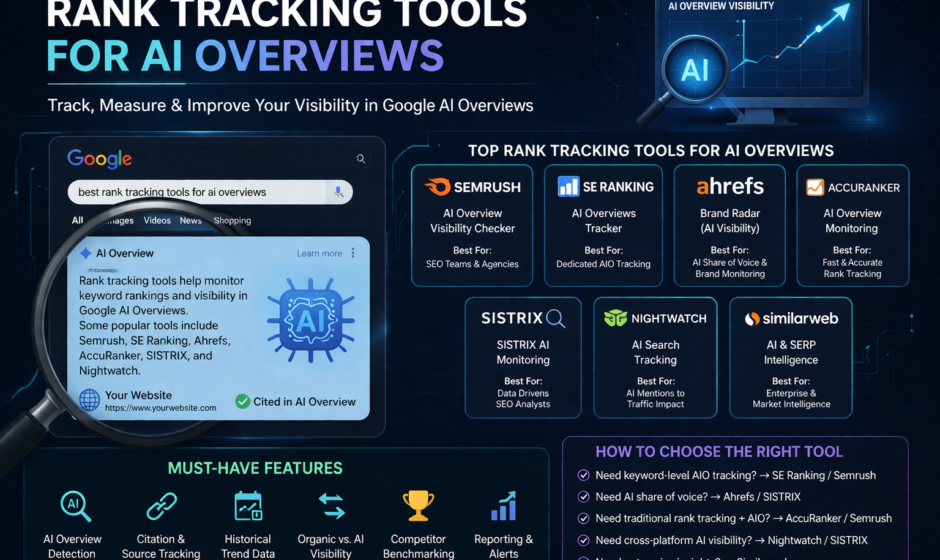

Search tracking has changed. It is no longer enough to monitor ten blue links and call it a day. Google AI Overviews now occupy valuable search real estate, and SEO teams increasingly need tools that can tell them not only where they rank organically, but also whether they appear inside AI-generated answers, how often those answers show up, which pages get cited, and how competitor visibility compares. Official product pages from Semrush, SE Ranking, AccuRanker, SISTRIX, Ahrefs, Nightwatch, and Similarweb all now describe AI Overview or broader AI search monitoring capabilities, which shows this category has become a real part of modern search tooling.
If you are searching for a rank tracking tool for AI Overviews, the core question is usually one of these: Which tool tracks Google AI Overviews for my keywords? Which platform shows whether my domain is cited in AI summaries? Which one compares traditional rankings and AI visibility side by side? Or which tool goes beyond Google and also tracks visibility in ChatGPT, Perplexity, Gemini, and other AI surfaces? Different vendors now solve different parts of that problem, so the best option depends on whether your priority is keyword-level SERP monitoring, AI citation tracking, competitor benchmarking, or broader brand visibility across AI search.
In simple terms, a good AI Overview rank tracking tool should answer five things clearly: does AI Overview appear for this keyword, am I cited in it, which page is cited, how often does this happen over time, and how do competitors compare? The strongest platforms now add historical data, filtered reporting, AI share of voice, citation source analysis, and workflow features that connect AI visibility to regular SEO work. That is why the category is moving from “rank tracking” into something closer to AI search visibility intelligence.
Why AI Overview rank tracking matters
Traditional rank tracking still matters, but it misses a big part of the new SERP. If AI Overview appears above or alongside standard results, your blue-link ranking alone does not fully describe what users see. Semrush explicitly states that Position Tracking shows which SERP features you appear in, including AI Overviews. SE Ranking likewise frames its AI Overviews Tracker around monitoring performance in Google AI Overviews, side-by-side keyword rankings, source analysis, and historical changes.
That matters because a site can have solid organic rankings and still lose attention if competitors are the ones repeatedly cited in AI-generated summaries. On the other hand, a site may gain visibility from AI citations even when it is not ranking first organically. Ahrefs’ Brand Radar and related Ahrefs materials are built around that exact shift, describing AI visibility, AI share of voice, top cited pages and domains, and brand presence in AI-generated answers rather than only classic rankings.
The category is also expanding beyond Google. Nightwatch, SISTRIX, Ahrefs, and SE Ranking all market broader AI search or LLM visibility features, covering platforms such as ChatGPT, Perplexity, Gemini, DeepSeek, or AI Mode-style interfaces. So when people ask for an AI Overview rank tracker, they often really need a tool that can bridge classic SEO and AI answer visibility together.
Best rank tracking tools for AI Overviews
1. Semrush
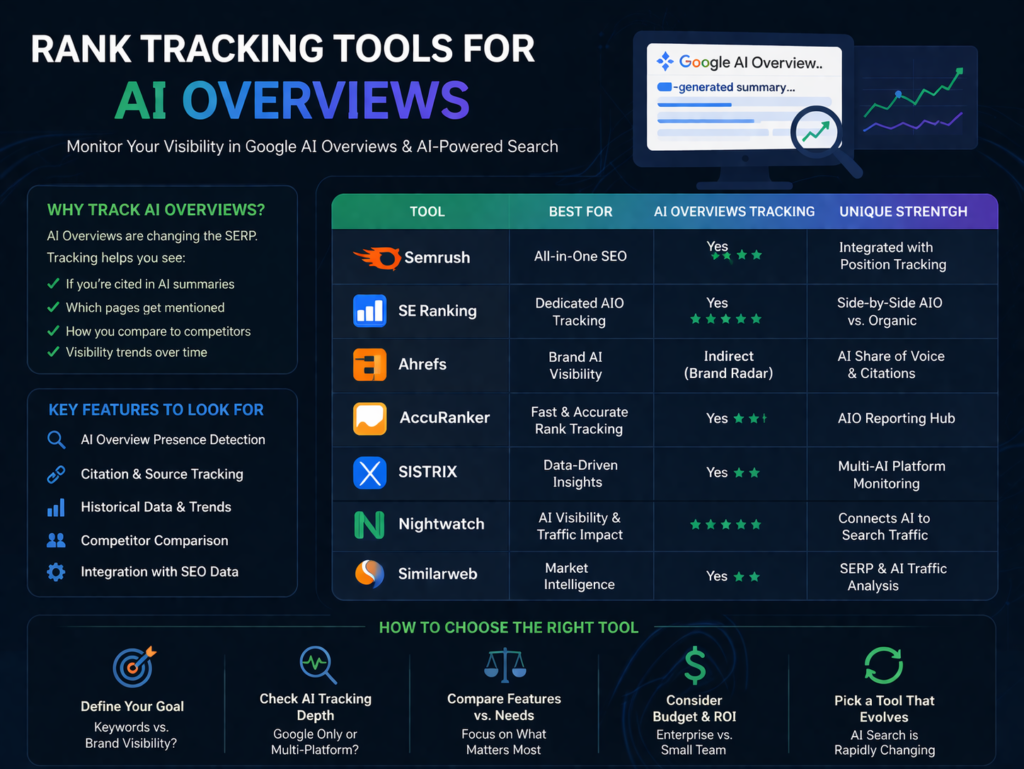
Semrush is one of the strongest choices if you want a familiar SEO suite that has added clear AI Overview tracking into its existing workflow. Its Position Tracking product monitors rankings daily by location, device, and engine, and Semrush’s documentation specifically says Position Tracking shows which SERP features you appear in, including AI Overviews. Semrush also offers an AI Overviews Visibility Checker focused on analyzing whether your pages appear in Google AI Overviews, how often they surface, and which competitors appear alongside you.
Semrush is a strong fit for agencies and SEO teams that already rely on its broader toolkit and want AI Overview monitoring without moving to a specialist platform. Its advantage is integration: organic rank tracking, competitor analysis, and AI Overview visibility can sit inside the same environment. Semrush’s own late-2025 guidance on tracking AI Overviews also shows it positioning the product around competitor benchmarking and AI Overview keyword opportunity discovery, which makes it useful for operational SEO planning rather than raw measurement alone.
2. SE Ranking
SE Ranking is one of the most direct answers to the query “rank tracking tool AI Overviews” because it has a dedicated AI Overviews Tracker page built specifically around this use case. SE Ranking says the tool lets you monitor performance in Google Search AI Overviews, compare rankings, analyze competitors and sources, view historical AI Overview data for keywords, and examine cached SERPs. It also says the tool provides side-by-side comparisons between traditional rankings and AI Overview rankings.
That side-by-side view is especially valuable for SEO teams trying to understand whether AI Overviews are replacing, complementing, or weakening the visibility they once got from regular organic positions. SE Ranking also markets a broader AI Visibility Tool for tracking brand mentions and links in AI answers, plus an AI Mode Tracker for mentions even when a website is not directly linked. That makes SE Ranking useful both for keyword-centric Google AI Overview tracking and for broader AI answer monitoring.
3. Ahrefs
Ahrefs approaches the category a little differently. Instead of positioning itself only as a keyword tracker for AI Overviews, it has leaned into AI visibility and brand presence in AI search. Ahrefs’ Brand Radar is described as a tool that tracks how any brand shows up in AI search across more than 300 million search-backed prompts, with features for benchmarking AI share of voice, identifying top cited pages and domains, and finding opportunities to get mentioned in AI answers.
Ahrefs also published guidance in 2026 saying that Site Explorer can help track actual AI Overview keywords, while Brand Radar gives the full picture across AI platforms. That means Ahrefs is especially strong for marketers who care about the broader question, “What do AI systems say about my brand, and how visible am I across AI-generated answers?” It is slightly less narrow than a pure AI Overview rank tracker, but in return it gives a bigger picture of AI search presence.
4. AccuRanker
AccuRanker remains a major rank tracking brand, and it has added explicit AI Overview monitoring into its product. Its help documentation describes an AI Overview page as the hub for monitoring AI Overviews and seeing how you appear in them, with graphs, tables, and charts for quick and detailed analysis. It also maintains documentation for the Google AI Overview SERP feature and explains AI Overviews as concise AI-generated summaries that usually appear at the top of search results.
AccuRanker looks like a strong option for teams that prioritize speed, structured reporting, and rank-tracker style workflows. It is especially appealing if you want AI Overviews as an extension of a traditional keyword-tracking environment rather than a separate brand-visibility platform. AccuRanker has also been moving into wider LLM monitoring through its AccuLLM messaging, which suggests it is treating AI Overview tracking as part of a larger AI search monitoring direction.
5. SISTRIX
SISTRIX is another strong choice, particularly for users who want AI monitoring built into a search visibility platform with a heavy data focus. Its SISTRIX AI product says users can discover how, where, and why their brand appears in AI answers across Google AI, ChatGPT, Perplexity, and DeepSeek, using real user data, clear metrics, and an efficient workflow. The main SISTRIX site also highlights AI Overview tracking and new AIO analysis features.
SISTRIX can be a very good fit for teams that think internationally or want to understand shifts in AI Overview frequency across markets. Its recent blog and product messaging have repeatedly tied AIO analysis to wider visibility changes in search, which suggests it is useful for analysts watching how AI features reshape SERP layouts and traffic patterns over time.
6. Nightwatch
Nightwatch has expanded from traditional SEO monitoring into AI search tracking. Its AI tracking pages say it helps users monitor exactly how AI models respond to queries about their industry and optimize content to be the recommended source. It also describes measuring share of voice across AI chats and connecting AI mentions to later search traffic. The main site positions Nightwatch as an AI-ready SEO monitoring tool that tracks the initial AI mention and subsequent search traffic for fuller attribution.
Nightwatch is therefore best for teams that do not want to isolate AI Overviews from the rest of the AI discovery journey. Its framing is broader than “did I appear in Google AIO for this keyword?” and closer to “how do AI systems mention my brand, and what search impact follows?” That makes it useful for brands trying to connect AI discovery, prompt visibility, citations, and downstream search behavior.
7. Similarweb / Rank Ranger
Rank Ranger branding has increasingly merged into Similarweb’s broader SEO and AEO stack, but the product pages still show it as relevant here. Similarweb’s rank tracker messaging says users can track keyword ranking in SERPs and AI Overviews, monitor visibility, clicks, and positions versus competitors, and view how the whole SERP is composed across organic, paid, and features. Another Similarweb SEO tools page mentions AI traffic in AI Search Intelligence, chatbot-source breakdowns, and landing-page visibility.
This makes Similarweb a compelling option for teams that care about AI Overviews but also want a fuller marketing intelligence context around traffic, competitors, and SERP composition. It may be less narrowly focused on AI Overview citations than SE Ranking or Semrush, but it can be a strong fit for enterprises that want AI visibility tied back to market-level competitive insight.
How to choose the right AI Overview rank tracker
If your primary need is keyword-level Google AI Overview tracking, SE Ranking, Semrush, and AccuRanker are among the clearest fits because they explicitly describe keyword monitoring, AI Overview presence, historical tracking, and reporting in a rank-tracker format. These are the tools most aligned with the classic SEO workflow of loading target keywords and checking positions daily.
If your real goal is brand visibility inside AI-generated answers, Ahrefs, SISTRIX, Nightwatch, and SE Ranking’s broader AI visibility products may be better choices. They emphasize AI share of voice, brand mentions, citations, cross-platform AI monitoring, and visibility even when a direct link is not present. That makes them more useful when you are measuring AI presence at the brand or topic level rather than a strict keyword-by-keyword SERP report.
If you want traditional SEO and AI search under one roof, Semrush and Ahrefs are particularly attractive because both already sit inside mature SEO suites. Similarweb can also fit that need for larger teams that want competitive and traffic context wrapped around the tracking.
If you want cross-platform AI search monitoring, SISTRIX, Ahrefs, and Nightwatch stand out because they explicitly discuss visibility beyond Google AI Overviews, covering AI answers or AI chats across multiple systems. This is increasingly important because many brands are no longer optimizing only for Google’s generative layer.
Features to look for in a rank tracking tool for AI Overviews
The first must-have is AI Overview detection. The tool should clearly tell you whether AI Overview appears for a tracked keyword and whether your site appears in it. Semrush, SE Ranking, and AccuRanker all explicitly describe this kind of monitoring in their materials.
The second is citation and source visibility. It is not enough to know that an AI Overview appeared. You need to know which pages or domains were cited. SE Ranking highlights source analysis, Ahrefs highlights top cited pages and domains, and Semrush’s visibility checker focuses on whether your pages surface and which competitors appear beside you.
The third is historical trend data. AI Overviews are not static. The tools need to show changes over time, because appearance frequency, citations, and competitive presence can shift quickly. SE Ranking explicitly highlights historical AIO data, while AccuRanker mentions graphs, tables, and charts for AI Overview analysis.
The fourth is comparison between organic and AI visibility. A good AI Overview rank tracker should help you understand both layers together, not separately. SE Ranking’s side-by-side comparisons make this explicit, and Similarweb’s SERP composition messaging aligns with the same need.
The fifth is competitor benchmarking. AI Overview SEO is often comparative. If your site is absent but a competitor is repeatedly cited, that gap matters. Semrush, Ahrefs, Nightwatch, SE Ranking, and Similarweb all position competitor comparison as part of their value.
Best use cases by tool
For agencies and in-house SEO teams already using a large suite, Semrush is one of the safest choices because it combines classic position tracking with AI Overview visibility tools in one platform.
For SEO teams that want a purpose-built Google AI Overview tracker, SE Ranking is arguably one of the strongest fits because it directly centers the product around AI Overview keyword monitoring, ranking comparisons, source analysis, and historical changes.
For brands focused on AI share of voice and reputation inside AI answers, Ahrefs is especially strong because Brand Radar is designed around brand-level AI visibility, cited sources, and cross-prompt benchmarking.
For rank-tracker-first teams that want clean reporting on AI Overviews, AccuRanker is attractive because it extends a familiar keyword monitoring workflow into AIO analysis.
For analysts who care about broader AI ecosystems and international visibility trends, SISTRIX is a strong pick because it connects AI answers, multiple AI platforms, and wider visibility data.
For brands trying to connect AI citations to later search behavior, Nightwatch is useful because its positioning explicitly ties AI mentions to subsequent search traffic and share of voice in AI search.
For enterprise teams that want AI Overviews in a wider market-intelligence stack, Similarweb is compelling because it links AI Overviews, SERP composition, chatbot traffic, and competitor intelligence.
Final verdict
The best rank tracking tool for AI Overviews depends on how narrowly or broadly you define the job. If you want the clearest keyword-level AIO tracker, SE Ranking is one of the most directly aligned products. If you want the best all-around SEO suite with AI Overview support, Semrush is a very strong choice. If you care most about AI share of voice and broader AI search visibility, Ahrefs stands out. If you prefer a traditional rank-tracker experience with AIO reporting, AccuRanker deserves serious consideration.
The bigger trend is clear: rank tracking is no longer just about positions. It is becoming a blend of keyword tracking, AI citation monitoring, brand visibility, and competitive intelligence across both search engines and AI answer systems. Any tool you choose should help you see that full picture, not just a partial one.
FAQs
What is a rank tracking tool for AI Overviews?
It is a tool that monitors whether Google AI Overviews appear for your tracked keywords and whether your site or pages are cited inside those AI-generated summaries. Some tools also track competitors, sources, and historical trends.
Which tool is best for tracking Google AI Overviews?
For dedicated Google AI Overview tracking, SE Ranking, Semrush, and AccuRanker are among the strongest options based on their official product pages and help documentation.
Can traditional rank trackers monitor AI Overviews?
Some can now do it. Semrush, AccuRanker, and Similarweb explicitly mention tracking AI Overviews within broader rank-tracking workflows.
What is the difference between AI Overview tracking and AI visibility tracking?
AI Overview tracking is usually keyword- and Google-specific. AI visibility tracking is broader and may include mentions across ChatGPT, Perplexity, Gemini, or other AI systems, often at a brand or prompt level.
Do I need both SEO rank tracking and AI tracking?
Usually yes. Organic rankings still matter, but AI Overviews and other AI answers change what users see first. The most useful platforms now help compare both layers together.