
Search is changing fast. Traditional SEO used to focus on rankings, clicks, impressions, backlinks, and organic traffic. That still matters, but it is no longer the full picture. Today, users increasingly interact with AI-generated answers inside search experiences instead of clicking straight through to websites. Google now describes AI Mode as a new way to search that uses advanced multimodal capabilities and a custom version of Gemini to help people ask more complex questions, follow up naturally, and explore with linked web sources.
That shift has created demand for a new category of software: the AI Mode SEO tool.
An AI Mode SEO tool is designed to help brands, publishers, and marketers understand how they appear in AI-generated search experiences, especially in Google AI Mode, but often also in AI Overviews, ChatGPT, Perplexity, Gemini, and other AI search surfaces. These tools go beyond classic rank tracking. Instead of asking only, “Where do I rank?” they ask more modern questions like:
- Am I mentioned in AI answers?
- Is my website being cited as a source?
- Which competitors are appearing instead of me?
- Which prompts trigger AI-generated responses?
- How is my brand represented inside these answers?
That is why this category matters. Google’s own documentation says AI features such as AI Overviews and AI Mode are part of Search from a site owner’s perspective, and Google advises creators to focus on helpful, satisfying, people-first content that adds unique value. Google also says that with AI Overviews and AI Mode, people are asking more complex questions and using Search more often.
So, if AI-generated search is becoming a larger part of discovery, brands need a way to measure visibility inside those AI experiences. That is where an AI Mode SEO tool comes in.
What Is an AI Mode SEO Tool?
An AI Mode SEO tool is a platform that helps track, analyze, and improve how a brand or website appears in AI-powered search experiences, particularly Google AI Mode. These tools usually monitor whether your pages are cited, whether your brand is mentioned, which prompts trigger AI responses, and how competitors compare. Vendor tools in this space position themselves around AI visibility, citations, mentions, and brand representation, not just standard organic ranking.
In simpler words, an AI Mode SEO tool is built for the new layer of search where the answer is often synthesized on the page. That makes it different from a classic SEO rank tracker.
A standard SEO platform might tell you:
- your keyword position
- your estimated traffic
- your backlink profile
- your technical SEO issues
An AI Mode SEO tool is more likely to tell you:
- whether Google AI Mode used your content
- how your brand was described in the answer
- what source domains were cited
- whether AI Mode showed competitors alongside you
- how often AI results replaced or overshadowed classic blue links
That difference is important because Google’s public AI search materials make clear that AI Mode is designed for more advanced, conversational, multimodal search behavior, and it uses web information plus Google systems to generate responses with links to explore further.
Why AI Mode SEO Tools Matter Now
AI search is changing user behavior. Google says AI Overviews and AI Mode help people ask longer, more complex questions and continue exploring with follow-ups. Google also says these experiences can surface links in different ways and expose users to a wider range of sources.
That means visibility is no longer limited to rank position on a traditional search engine results page.
For many marketers, the new problem is this: even if your site ranks organically, an AI-generated answer may summarize the topic before the user ever clicks. If your content is not cited, or your brand is not mentioned, you can become less visible even when your classic SEO looks strong. Several SEO software providers now explicitly market tools for tracking Google AI Mode, AI Overviews, and AI search visibility for this reason.
So, AI Mode SEO tools matter because they help answer questions that Google Search Console and older SEO dashboards do not fully answer today.
How Google AI Mode Changes SEO
Google’s official AI search documentation gives useful context for why these tools exist.
Google explains that AI Mode is part of its AI search experiences and is meant to help with planning, researching, brainstorming, and handling complex questions. Google also says AI Mode uses a “query fan-out” technique, which means it can issue multiple related searches across subtopics and combine information into a richer response.
From an SEO perspective, that changes several things.
1. Search queries become more conversational
Instead of short keywords, users may ask full questions with layered intent. That makes prompt-based visibility more important than simple keyword position. Google explicitly frames AI Mode around tougher, more natural questions.
2. Source selection matters more
If AI Mode composes an answer from several sources, then being one of the cited sources becomes strategically important. A page might influence the answer without being the first blue link.
3. Brand visibility becomes more interpretive
AI-generated responses can mention brands directly, summarize them, compare them, or leave them out entirely. That means SEO is no longer only about document ranking. It is also about how an AI system represents entities.
4. Click behavior may change
If users get a strong answer on-page, some will click less. SEO teams therefore need to measure influence and presence, not only traffic. Vendor platforms built for AI search now emphasize citations, mentions, and AI visibility because of this shift.
What an AI Mode SEO Tool Tracks
Most AI Mode SEO tools are built around a group of new metrics.
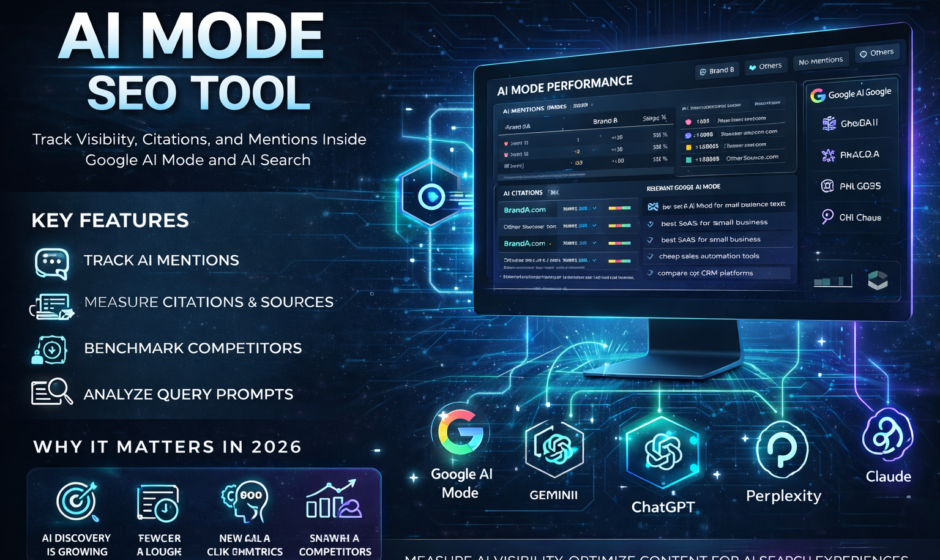
AI mentions
These track whether your brand, products, or website are named in AI-generated answers. This is useful because users may remember the recommendation even if they do not click.
Citations and source attribution
These show whether your domain is used as a cited source. Some tools also record citation order or link placement inside AI results. Providers such as SE Ranking and Advanced Web Ranking explicitly describe AI Mode tracking around citations, link placement, and AI source visibility.
Prompt or query coverage
These show which prompts trigger AI Mode and where your brand appears across those prompts. This matters because AI search is often prompt-driven, not just keyword-driven.
Competitor presence
Many AI answers compare brands. AI Mode SEO tools often show which competitors are mentioned alongside you or instead of you. Advanced Web Ranking’s AI brand visibility materials describe tracking competitors mentioned alongside your brand across AI search engines.
Sentiment or representation
Some tools try to analyze whether the brand mention is positive, neutral, or negative. This is useful because being mentioned is not always a win if the framing is unfavorable.
Market and location differences
Some platforms market tracking across countries and devices because AI search visibility can vary by location. Advanced Web Ranking says it tracks AI visibility across 170+ countries, while Google’s AI experiences also vary by availability and rollout.
Key Features to Look For in an AI Mode SEO Tool
Not every platform in this category does the same job. The best choice depends on your goals.
Google AI Mode tracking
This is the core requirement if your main goal is visibility in Google’s AI search experience. Some platforms now explicitly advertise Google AI Mode tracking and analysis.
AI Overviews tracking
Since AI Overviews remain a major Google AI surface, it helps if the tool also covers them. Google presents AI Overviews and AI Mode together in its official guidance for site owners.
Cross-platform AI visibility
Many marketers do not want to monitor Google alone. Some vendors now track AI visibility across ChatGPT, Perplexity, Gemini, Claude, and Google AI surfaces.
Citation and mention reports
The tool should show exactly when and where your content is cited, not just a vague visibility score.
Query-level detail
A strong tool should let you drill into specific prompts, not just see aggregate trends.
Competitive benchmarking
You want to know who is taking visibility share when you are absent.
Reporting and export options
This matters for agencies, enterprise teams, and internal stakeholder updates.
Historical tracking
AI search is volatile. Without historical data, it is hard to see whether visibility is improving.
How an AI Mode SEO Tool Differs From Traditional SEO Software
An AI Mode SEO tool does overlap with standard SEO tools, but it is not the same thing.
Traditional SEO software focuses on:
- rankings
- crawl errors
- backlinks
- on-page optimization
- keyword research
- site audits
AI Mode SEO tools focus more on:
- AI answer visibility
- citations
- mentions
- response analysis
- entity representation
- prompt coverage
- cross-engine AI visibility
This distinction is already visible in the way vendors market these products. Advanced Web Ranking, for example, now separates classic ranking from AI Search Visibility, highlighting how brands appear in Google AI Mode, AI Overviews, ChatGPT, Perplexity, Gemini, and Claude. seoClarity and SE Ranking also market dedicated AI Mode tracking rather than only traditional ranking data.
So, the point is not that traditional SEO tools are obsolete. It is that they are no longer enough by themselves.
Who Should Use an AI Mode SEO Tool?
This type of tool is especially useful for businesses that rely on search visibility during research and comparison.
SaaS brands
Software buyers ask detailed, comparison-heavy questions. AI answers can strongly shape the shortlist before the user visits any site.
Ecommerce brands
Shoppers increasingly ask AI systems to compare products, explain differences, recommend options, or summarize features.
Publishers and content teams
Editorial publishers need to know whether their reporting is becoming source material for AI-generated answers.
Agencies
Agencies need new reporting layers for clients whose visibility is now affected by AI search experiences.
Local and multi-market brands
Brands operating across countries or regions benefit from tools that show how AI visibility shifts by market.
Best Practices for Optimizing for AI Mode
Google’s own guidance is still the most important starting point here. Google says content creators should focus on people-first, helpful, original, satisfying content and think about inclusion in AI features the same way they think about creating value for visitors. Google has also said that using AI to help generate content is not inherently against its guidance, as long as the result is helpful and not created primarily to manipulate rankings.
Based on Google’s guidance and how AI search tools work, the main optimization principles are:
Create original, useful content
Thin, repetitive, search-first pages are less likely to be strong sources.
Answer real user questions
AI Mode is built for complex questions. Content that directly solves those questions is more likely to be useful.
Build clear entity signals
Make it obvious who you are, what you do, and why your page is authoritative.
Use strong topical structure
Pages that clearly explain subtopics, comparisons, definitions, steps, and use cases may be easier for AI systems to interpret.
Improve source trust
Brands with stronger reputation signals, clearer expertise, and higher-quality content are better positioned for citation over time.
Track and iterate
AI search visibility changes fast. A good AI Mode SEO tool helps you identify which prompts you are winning, losing, or missing.
Common Misunderstandings About AI Mode SEO Tools
“It replaces SEO.”
It does not. It expands SEO measurement into AI-generated search environments.
“It guarantees AI visibility.”
No tool can guarantee that. These platforms help measure and guide optimization. They do not control Google or other AI systems.
“It is only for large enterprises.”
Large brands benefit a lot, but agencies, SaaS companies, ecommerce stores, and publishers can all use it.
“It is just rank tracking with a new label.”
Not really. AI Mode tracking measures a different layer of search behavior, especially citations, mentions, and synthesized-answer visibility.
Challenges and Limitations
This category is promising, but it is still evolving.
First, AI search itself changes quickly. Google’s AI experiences continue to evolve, and vendors regularly update how they track them.
Second, different tools define metrics differently. One platform’s “visibility” score may not match another’s methodology.
Third, personalization and volatility can affect results. AI answers may vary by query phrasing, market, device, and testing environment.
Fourth, public data is still limited. Much of what is available today comes from official Google documentation plus vendor documentation, so teams should evaluate claims carefully and test platforms against their own workflows.
The Future of AI Mode SEO Tools
This category will likely grow quickly because AI search is becoming a normal part of how people discover information. Google continues to position AI Mode and AI Overviews as major parts of modern Search, and SEO software companies are already building dedicated products around tracking AI visibility.
Over time, AI Mode SEO tools will likely become more useful in several ways:
- better citation analysis
- more prompt coverage
- cross-engine visibility dashboards
- stronger competitive intelligence
- integration with content planning workflows
- improved market-level reporting
- historical trend analysis for AI surfaces
In other words, this is not a passing label. It looks like an early but important category in modern search marketing.
Final Thoughts
An AI Mode SEO tool is software built to measure and improve your visibility inside AI-generated search experiences, especially Google AI Mode. It exists because classic SEO metrics no longer tell the whole story. As Google’s AI search experiences become more conversational, multimodal, and answer-driven, brands need to know whether they are being cited, mentioned, and represented well inside those answers.
The best AI Mode SEO tools help teams monitor citations, mentions, competitors, prompt coverage, and AI visibility trends across Google AI Mode and, in many cases, other AI search platforms too.
For marketers, publishers, SaaS companies, and agencies, this category matters because search is no longer only about where you rank. It is also about whether AI systems use your content, mention your brand, and present you as a trusted answer.
That is why AI Mode SEO tools are becoming part of the new SEO stack.
FAQs
What is an AI Mode SEO tool?
An AI Mode SEO tool is a platform that tracks and analyzes how your brand or website appears in AI-powered search experiences, especially Google AI Mode. It often measures mentions, citations, and AI visibility rather than only traditional rankings.
Does Google have an official AI Mode SEO tool?
Google provides official guidance for site owners about AI features such as AI Overviews and AI Mode, but that guidance is not a dedicated third-party-style AI visibility tracker. Specialized tracking tools are currently offered by SEO software vendors.
Is AI Mode the same as AI Overviews?
No. Google presents both as AI search experiences, but AI Overviews and AI Mode are distinct experiences. Google describes AI Mode as a more advanced, conversational search mode for deeper exploration.
What should an AI Mode SEO tool measure?
The most useful metrics usually include AI mentions, citations, source attribution, competitor presence, prompt coverage, and historical visibility trends. These are the kinds of metrics vendors in this space highlight.
Can an AI Mode SEO tool improve rankings?
Indirectly, it can help improve visibility by showing where your content is missing from AI answers and where optimization is needed. But the tool itself does not change rankings on its own.
What is the best strategy for AI Mode SEO?
Google’s own advice remains the strongest baseline: create helpful, people-first, original content that adds unique value, and avoid making content primarily for search engines instead of users.