
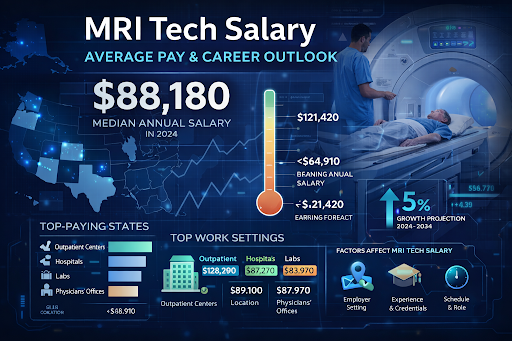

If you are researching MRI tech salary, you are probably trying to answer one practical question: How much can an MRI technologist actually earn? The answer is encouraging. According to the U.S. Bureau of Labor Statistics, the median annual wage for magnetic resonance imaging technologists was $88,180 in May 2024, with the lowest 10 percent earning less than $64,910 and the highest 10 percent earning more than $121,420. The BLS also reports that MRI technologists working in outpatient care centers had a notably high median wage of $128,290, compared with $89,100 in hospitals, $87,270 in medical and diagnostic laboratories, and $83,970 in physicians’ offices.
That official BLS figure gives the clearest national benchmark, but real-world pay can look different depending on location, shift type, certification, employer setting, and whether the role is staff, lead, or travel-based. Indeed’s current pay data, based on job-posting salary information, estimates an average of $2,445 per week for MRI technologists in the United States, updated March 22, 2026. That posting-based figure is not the same as the BLS median wage, but it shows that current market demand remains strong and that many MRI tech roles are being advertised at competitive rates.
The MRI field also benefits from a healthy long-term employment outlook. The BLS projects 5 percent growth for radiologic and MRI technologists from 2024 to 2034, which is faster than the average for all occupations, along with about 15,400 openings each year on average across the decade. For anyone evaluating whether MRI is worth the training, that matters because salary is only part of the picture. Consistent demand, a healthcare setting, and the ability to build specialty credentials all make MRI a strong career path for many imaging professionals.
What is the average MRI tech salary?
The most reliable salary benchmark for this career is the BLS median annual wage of $88,180 for MRI technologists in May 2024. Median pay matters more than a simple average because it shows the middle point of the profession: half of MRI technologists earned more than that figure and half earned less. The BLS range also shows meaningful earning potential over time, with top earners crossing $121,420 annually.
To translate that into more practical terms, the BLS median annual wage of $88,180 works out to roughly $7,348 per month, about $1,696 per week, or around $42.39 per hour if you assume a standard full-time schedule. That hourly figure is a calculation based on the BLS annual median, not a separate BLS published hourly median.
Indeed’s estimate of $2,445 per week suggests that some currently advertised roles, especially in competitive markets or premium shifts, may pay above the long-run median reported by the BLS. This difference is not necessarily a contradiction. BLS salary data is a broad government wage benchmark, while Indeed reflects salary information taken from recent job postings and employer-submitted data. In practice, both are useful: BLS tells you the stable national picture, and Indeed gives a sense of the live hiring market.
MRI tech salary by work setting
One of the biggest factors affecting MRI tech salary is where you work. The BLS reports clear differences by industry. Among the top industries employing MRI technologists, outpatient care centers pay the highest median wage at $128,290. Hospitals come next at $89,100, followed by medical and diagnostic laboratories at $87,270, and offices of physicians at $83,970.
This is important because many people assume hospital jobs always pay the most. In MRI, that is not always true. Outpatient settings can sometimes pay more because of specialized workflows, efficiency demands, private imaging models, or regional staffing pressures. Hospitals still remain a major employer and often offer solid pay paired with benefits, shift differentials, and broader career development, but outpatient imaging clearly stands out in the federal wage data.
For job seekers, this means your salary strategy should not focus only on title. Two jobs with the same title, “MRI technologist,” can pay very differently depending on whether they are based in a hospital, imaging center, lab, or physician-owned practice. A candidate comparing offers should weigh base pay, overtime, benefits, weekend requirements, call duty, and long-term growth rather than looking only at the headline number.
MRI tech salary by location
Location can make a major difference in MRI pay. In the most recent BLS state wage profile surfaced in search results, the top-paying states for MRI technologists included California at $114,680, Alaska at $109,830, Washington at $109,750, Oregon at $106,620, and Hawaii at $106,610. These figures come from BLS state wage data for MRI technologists.
These higher-paying states often also have higher living costs, so salary should always be interpreted alongside housing, taxes, transportation, and overall cost of living. A job that pays less on paper in a more affordable region can still produce a stronger lifestyle outcome than a six-figure salary in a very expensive market. That part is an inference based on general compensation reasoning, but it is a critical one for anyone comparing MRI tech offers across states.
Regional shortages also matter. Areas struggling to recruit qualified imaging staff often offer stronger pay packages, sign-on bonuses, or differential pay for evenings, nights, or weekends. That helps explain why job-posting data and state wage data can vary so much from one market to another.
What factors affect MRI tech salary?
Several key factors influence how much an MRI technologist earns. The first is experience. Entry-level MRI technologists usually start lower and move up as they gain scanner confidence, patient-handling ability, contrast experience where applicable, and workflow speed. While the BLS does not break MRI tech salary down by early-career and late-career levels in the source cited here, its wage range from below $64,910 to above $121,420 clearly shows that earnings spread significantly within the profession.
The second factor is credentials and pathway. ARRT states that MRI certification and registration can be earned through either a primary or postprimary pathway. ARRT also says its certification and registration requirements are built around education, ethics, and examination. For the primary pathway, candidates must earn an associate degree or higher and complete an ARRT-approved educational program in the same discipline. These credentials do not automatically guarantee a specific salary, but they are central to employability and professional progression.
The third factor is setting and schedule. MRI technologists working nights, weekends, holidays, or on-call shifts may earn more through differential pay. Lead roles can also increase salary. Indeed’s salary data page for lead MRI technologists lists an average of $100,111 per year in the United States, suggesting supervisory or advanced positions can meaningfully raise earnings.
The fourth factor is market type, including permanent staff versus contract or travel roles. Indeed’s national job-market snapshot of $2,445 per week hints that current advertised roles can be quite strong in some segments of the market. These opportunities may not reflect every full-time staff role, but they show that demand remains favorable in many hiring environments.
Entry-level MRI tech salary
Many prospective students want to know what an entry-level MRI tech salary looks like. The BLS does not publish a separate “entry-level” MRI technologist figure in the source cited here, but it does report that the lowest 10 percent of MRI technologists earned less than $64,910 in May 2024. In practice, entry-level earnings often begin closer to the lower end of the profession and then rise with certification, experience, and employer changes.
That said, entry-level does not always mean low for long. MRI is a specialized imaging field, and once technologists become comfortable with clinical protocols, patient communication, safety screening, positioning, and department pace, they often become more valuable very quickly. This is especially true if they can work independently, handle difficult schedules, or expand into leadership or cross-training roles. That point is an inference, but it aligns with how specialized healthcare roles typically reward experience and flexibility.
For students evaluating the return on investment, the salary floor in MRI is still comparatively strong against many allied health careers that require similar or greater training time. The BLS median wage of $88,180 also suggests significant room for growth beyond the early-career stage.
How to become an MRI technologist
Salary and qualifications are closely connected, so anyone researching MRI pay should understand the training path. ARRT says MRI certification and registration are available through primary and postprimary eligibility pathways. ARRT also states that the primary pathway requires an associate degree or higher plus completion of an ARRT-approved educational program in the same discipline. In addition, ARRT’s broader requirements page says candidates must meet standards in education, ethics, and examination.
This matters because employers often prefer or require recognized credentials, and those qualifications support salary growth over time. For radiographers already in the field, ARRT’s postprimary route creates a path into MRI specialization, which may open doors to better-paying opportunities or more focused imaging roles.
The BLS Occupational Outlook Handbook also lists the typical entry-level education for MRI technologists as an associate’s degree. That makes MRI an attractive option for people looking for a respected healthcare profession without the longer educational timeline of some other medical careers.
MRI tech salary compared with other imaging careers
MRI is often compared with other imaging specialties. Based on current BLS data, the median annual wage for MRI technologists was $88,180 in May 2024. For comparison, the BLS reports $77,660 for radiologic technologists and technicians, $89,340 for diagnostic medical sonographers, $97,020 for nuclear medicine technologists, and $101,990 for radiation therapists.
This comparison shows that MRI sits in a strong middle-to-upper range within imaging and therapy-related allied health careers. It pays more than general radiologic technologist roles at the median level, is very close to diagnostic sonography, and trails some more narrowly specialized fields such as nuclear medicine and radiation therapy. That does not make MRI less attractive. Many people choose MRI because it combines strong pay, a focused technical specialty, good demand, and a training path that is accessible compared with some other advanced healthcare careers.
Is MRI tech a good career for salary?
From a salary perspective, MRI is a solid healthcare career choice. The BLS median of $88,180 is well above the general median wage for all workers in the United States, and the upper end of the field crosses $121,420. On top of that, employment is projected to grow 5 percent from 2024 to 2034, with thousands of openings each year.
It is also a career with multiple ways to improve earning power. MRI technologists can increase their income by moving into higher-paying settings such as outpatient care centers, relocating to stronger-paying states, taking lead roles, working premium shifts, or building additional specialty credentials. ARRT’s credential structure supports that idea by recognizing multiple disciplines and pathways for imaging professionals.
Of course, salary is not the only reason people enter MRI. The job also carries clinical responsibility, patient interaction, technical skill, safety knowledge, and the need for precision under pressure. Anyone entering the profession should value the work itself, not just the paycheck. But taken as a whole, the salary outlook is clearly strong enough to make MRI a worthwhile option for many healthcare-focused students and professionals.
How to increase your MRI tech salary
If you want to maximize MRI tech salary, the most practical strategies are straightforward. First, earn strong credentials and stay in good standing professionally. ARRT certification and registration remain a key benchmark in the field, and maintaining recognized qualifications supports mobility and advancement.
Second, target employers strategically. The BLS wage data shows a major pay gap between outpatient care centers and other common settings. Choosing the right type of employer can significantly affect long-term income.
Third, consider location carefully. States such as California, Alaska, Washington, Oregon, and Hawaii show stronger wage levels in BLS state data. Higher salaries in these markets may or may not translate into better take-home lifestyle value after living costs, but they absolutely affect headline earnings.
Fourth, look for advancement routes. Lead MRI technologist roles, specialized settings, or broader imaging experience may all improve pay. Indeed’s lead MRI technologist data suggests a six-figure path is realistic for some advanced roles.
Finally, pay attention to the live market. Government salary data is excellent for benchmarks, but current job-posting data can reveal hot markets, urgent staffing needs, and above-average pay opportunities. Indeed’s current national estimate is a useful signal that demand remains healthy.
Job outlook for MRI technologists
The long-term employment outlook adds even more value to the salary picture. The BLS projects 5 percent growth in employment for radiologic and MRI technologists from 2024 to 2034, which is faster than average, along with about 15,400 openings per year. This means the profession is not only reasonably well paid, but also expected to remain relevant and needed.
Growth matters because salary is easier to negotiate in a field with stable or rising demand. Openings created by retirements, workforce turnover, and healthcare service needs all support ongoing hiring. In practical terms, that gives MRI technologists more room to compare opportunities, relocate, or seek better-paying roles over time.
Final thoughts on MRI tech salary
The current answer to the question “How much does an MRI tech make?” is strong and fairly clear. The BLS median annual wage is $88,180, the upper end of the field exceeds $121,420, and top-paying settings such as outpatient care centers can reach a median of $128,290. Current job-posting data also suggests an active hiring market, with Indeed estimating $2,445 per week nationally.
For someone looking at healthcare careers with a good balance of technical skill, respectable income, and stable demand, MRI remains a very attractive option. The field offers a solid baseline salary, room for specialization, and a growth outlook that supports long-term career planning.
FAQs about MRI tech salary
What is the average MRI tech salary in the U.S.?
The U.S. Bureau of Labor Statistics reports a median annual wage of $88,180 for MRI technologists in May 2024.
How much do entry-level MRI techs make?
The BLS does not publish a separate entry-level figure in the cited source, but it reports that the lowest 10 percent earned less than $64,910 in May 2024.
What setting pays MRI technologists the most?
Among the top industries listed by BLS, outpatient care centers had the highest median wage at $128,290.
What are the highest-paying states for MRI techs?
In the latest BLS state wage results surfaced here, the highest-paying states included California, Alaska, Washington, Oregon, and Hawaii.
Is MRI tech a good career?
It can be. MRI technologists earn strong median pay and the BLS projects 5 percent employment growth from 2024 to 2034