
Search has changed fast. It is no longer only about blue links, keyword positions, and organic click-through rates. Today, people ask ChatGPT, browse Google AI Overviews, and compare answers in Perplexity before they ever visit a website. That shift has created a new visibility problem for brands. A company may still rank in traditional search, yet remain almost invisible inside AI-generated answers.
That is where the Ziptie AI search performance tool stands out.
Ziptie is built to help brands understand how they appear inside AI search environments. According to its official product and FAQ pages, the platform tracks brand visibility across Google AI Overviews, ChatGPT, and Perplexity, while also providing recommendations to improve AI search presence. It is centered on three core modules: AI Search Monitoring, Content Optimization, and Insights & Recommendations.
For businesses, agencies, and SEO teams, that makes Ziptie relevant for a very simple reason: it measures the kind of visibility that more traditional SEO platforms were not originally designed to measure. Instead of only asking, “Where do I rank?” it helps teams ask, “Does my brand show up in AI answers, how is it described, and what can I improve?”
The Bigger Reason Ziptie Matters
The rise of AI search has changed what performance means. On Ziptie’s official site, the company positions itself around AI search visibility, identification of influential sources driving AI responses, and performance measurement beyond traditional metrics. Its messaging reflects a real market need: being visible in AI-generated answers is not the same as being visible in classic search listings.
That difference matters because AI systems summarize, compare, recommend, and cite. In many cases, the user never needs to click ten blue links to get a quick answer. If your brand is not named, cited, or framed well in those AI outputs, you can lose visibility before the customer even reaches your website.
This is one of the strongest arguments for choosing Ziptie. It is not trying to be a generic analytics tool. It is focused on AI answer visibility. That specialization is one of its clearest advantages.
1. Ziptie Tracks the AI Platforms That Matter
A major reason to choose Ziptie is coverage. Its official FAQ states that it tracks performance across Google AI Overviews, ChatGPT, and Perplexity, and that it monitors the market for additional engines as they gain traction.
That matters because brands are no longer dealing with one search experience. A customer may:
- ask ChatGPT for the best software in a category
- check Google AI Overviews for a quick summary
- use Perplexity to compare vendors and sources
If your monitoring only covers one of those environments, your view of performance is incomplete. Ziptie addresses that by putting several major AI search surfaces in one workflow. Officially, it presents this as one of its core benefits: monitoring all major AI search platforms in one place.
For marketers, that means fewer blind spots. For agencies, it means cleaner reporting. For leadership teams, it means a more realistic picture of how modern search visibility actually works.
2. It Focuses on Visibility, Not Just Rankings
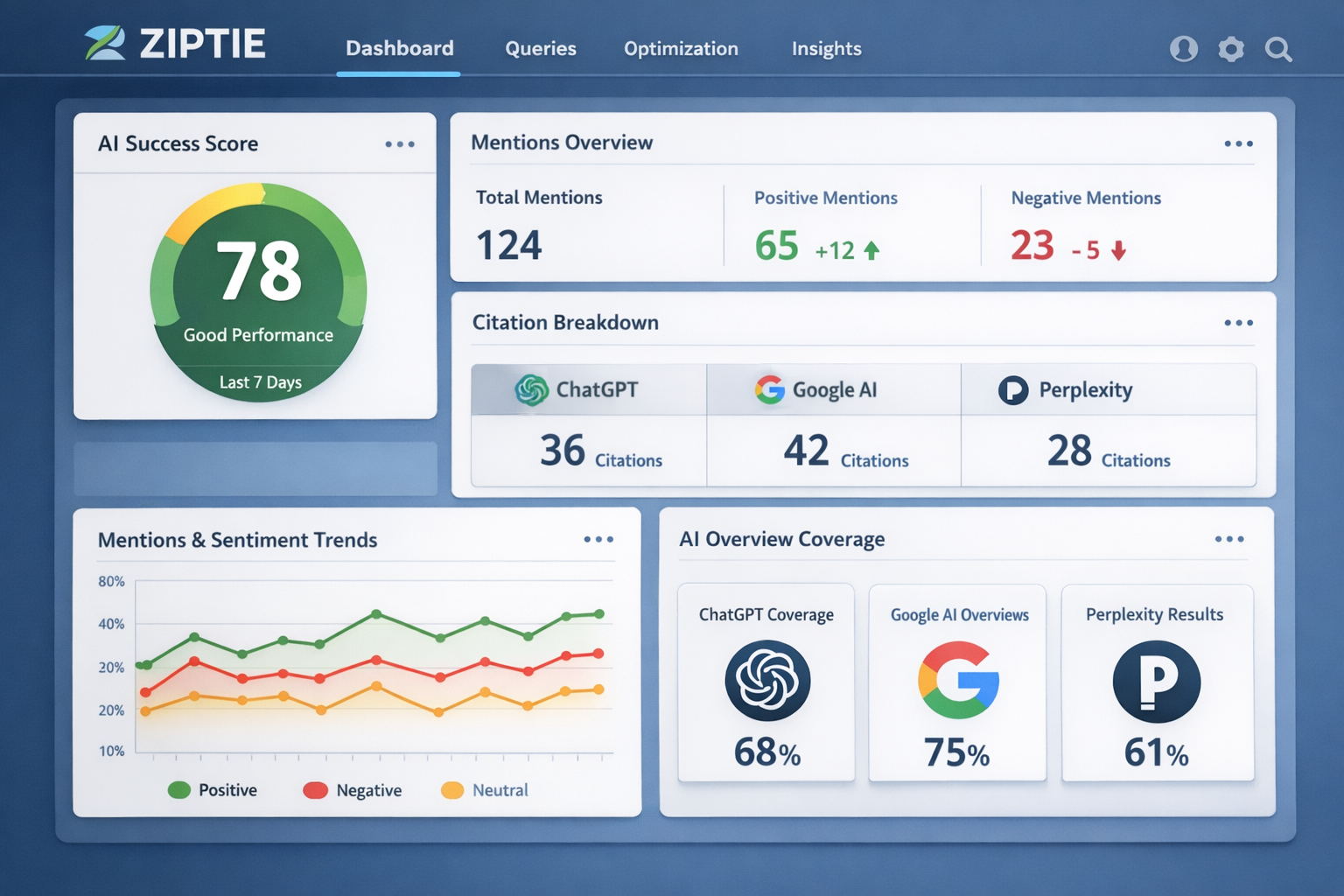
Traditional SEO tools are still useful, but Ziptie is built around a different measurement model. Its official materials say it tracks:
- brand mentions
- sentiment analysis
- citation tracking
- competitive benchmarking
- AI Overview coverage
- full response text
This is important because AI search is more nuanced than position tracking. A brand can be mentioned positively, negatively, or not at all. It can be cited directly, referenced loosely, or overshadowed by competitors. A page can influence an answer even when the user never clicks the source link.
Ziptie is useful because it measures those layers.
That gives teams a richer understanding of performance. Instead of saying, “We rank in third position,” they can say, “We were cited in ChatGPT, absent from Perplexity, and described more weakly than a competitor in Google AI Overviews.” That is much more actionable.
3. It Includes an AI Success Score for Faster Prioritization
One of Ziptie’s recurring differentiators is its AI Success Score. The company describes this as a way to understand overall AI performance more quickly, and its Insights tab surfaces that score at the top of the dashboard.
Why does this matter?
Because most marketing teams do not suffer from a lack of raw data. They suffer from too much scattered data and too little prioritization. A score helps turn a messy stream of AI visibility signals into something easier to review and act on.
Ziptie also states that AI success scores help users decide which queries to optimize first for maximum impact.
That is a practical advantage. Instead of chasing every prompt equally, teams can focus on the queries and categories that have the most strategic value.
4. It Helps Discover the Right Queries to Track
A common AI search problem is not knowing what to monitor in the first place. Ziptie addresses that directly.
Its official materials say the platform includes a query generator that helps users discover relevant prompts, and another official post explains there are three ways to add queries:
- use the built-in generator
- import queries from Google Search Console
- enter queries manually
This is one of the clearest reasons to choose Ziptie over a more manual workflow.
Most teams can brainstorm a few branded prompts. Far fewer can reliably build a strong prompt universe that reflects how real people ask category questions inside AI systems. Ziptie’s official readiness guide also says its query generator analyzes actual content URLs to produce relevant, industry-specific queries and reduce the guesswork of manual setup.
That means a business can start with what it already has, then expand into the kinds of questions customers are actually asking.
5. Ziptie Measures Real AI Search Experiences
One of the most compelling official claims on Ziptie’s site is that it tracks real user experiences rather than relying on API-based analysis, which it says helps visibility data reflect what customers actually see.
That point matters a lot.
AI platforms often behave differently in real interfaces than they do in simplified test conditions. Results can vary by interface, location, phrasing, and context. So if a tool only approximates AI search behavior, the data may not reflect the actual user experience.
Ziptie presents itself as a tool built to reduce that gap. For brands making content, PR, SEO, and positioning decisions based on AI search visibility, that can be a meaningful advantage.
6. It Connects Monitoring With Optimization
A lot of tracking tools stop at visibility reports. Ziptie tries to go further.
Its official FAQ says the platform does more than monitoring. It also offers content optimization recommendations and strategic insights to improve visibility. Its product structure names Content Optimization as one of the three core modules.
In a separate official article, Ziptie says its content optimization feature analyzes what ChatGPT, Perplexity, and Google AI Overviews require, identifies specific gaps in existing content, and recommends ways to improve quality and fill those gaps.
This is one of the strongest reasons to choose the tool.
Teams do not just need to know that they are missing from AI answers. They need to know what to fix. Ziptie aims to shorten the path from diagnosis to action.
7. It Gives You Multiple Ways to View Performance
Ziptie says users can analyze data at three levels:
- project overview
- category level
- query level
That flexibility matters because different stakeholders need different views.
An executive may want a simple project-wide summary. A strategist may want category-level trends. A content lead may need to inspect one query and compare the response text, citations, and sentiment.
This layered approach makes the tool more useful across teams. It also makes reporting more practical. You can stay high-level when needed, then drill into detail without switching systems.
8. It Supports Competitive Benchmarking
Ziptie’s official FAQ says it tracks competitive benchmarking as part of AI search success measurement.
That is valuable because AI visibility is relative. It is not enough to know whether your brand appears. You also need to know who appears beside you, who gets cited more often, and where competitors are outperforming you.
When AI engines repeatedly mention a competing brand in category questions, that shapes perception early. It influences buyer trust before a traditional site visit or demo request ever happens.
A tool that surfaces those competitive gaps is much more useful than one that simply confirms your own presence.
9. Ziptie Is Built by SEO Specialists for the AI Search Landscape
On its official FAQ page, Ziptie describes itself as built by SEO experts specifically for the AI search landscape.
That matters because AI search optimization is not only a technical problem and not only a content problem. It sits between SEO, brand positioning, content quality, query intent, and source authority.
A tool shaped by SEO thinking is more likely to reflect how discoverability actually works online. It can help marketers connect AI visibility with broader digital strategy instead of treating AI search as a disconnected trend.
10. It Supports Multi-Region Tracking
Ziptie’s official site says it monitors results across multiple countries and regions, including the US, Canada, Australia, UK, India, and Brazil.
This is especially useful for:
- international brands
- agencies with multi-country clients
- SaaS companies serving several markets
- businesses comparing regional AI visibility differences
AI-generated outputs can vary by geography, language context, and market behavior. A tool with region-aware tracking helps brands avoid assuming that one result pattern applies everywhere.
11. It Offers Ongoing Reporting
According to its FAQ, Ziptie allows users to choose weekly reports for monitoring or more frequent updates for active optimization campaigns.
That is useful because different teams operate on different rhythms. Some need regular executive reporting. Others are running active content changes and want faster feedback.
This reporting flexibility makes Ziptie easier to fit into existing workflows rather than forcing teams into a one-size-fits-all model.
12. It Has a Clear, Practical Setup Process
Ziptie’s official FAQ simplifies usage into three steps:
- set up the project
- monitor performance
- optimize with insights
That may sound basic, but simplicity matters. Many emerging AI search tools look interesting but create friction during onboarding. Ziptie’s model is easier to understand: start the project, add the right queries, review performance, then work on recommendations.
Its official post also mentions a 14-day free trial, with the note that the trial excludes Google Search Console integration.
For many teams, that lowers the barrier to testing whether the platform is actually useful before a larger commitment.
Who Should Choose Ziptie?
Ziptie is especially useful for organizations that care about how they are represented inside AI-generated answers, not just in classical search results.
Agencies
Agencies can use Ziptie to show clients where they appear in AI search, how competitors compare, and what content improvements could close visibility gaps. The ability to view performance at project, category, and query level supports both executive reporting and tactical work.
In-house SEO teams
SEO teams can use Ziptie to add AI search monitoring to their workflow without abandoning their existing SEO stack. The query generator, citation tracking, and content gap analysis can help them move from standard rankings into AI discoverability.
Content marketers
Content teams can use Ziptie to understand which topics, pages, and narratives influence AI responses. That can shape content updates, editorial calendars, comparison pages, and authority-building efforts.
SaaS and B2B brands
For brands that rely on trust, comparison, and category education, AI answers can influence prospects very early. Ziptie can help identify whether the brand is present at those moments and whether the framing is working.
Multi-market businesses
Because Ziptie supports several countries, it is useful for brands that need visibility intelligence across more than one market.
When Ziptie Makes the Most Sense
Ziptie is a smart choice when your team is asking questions like these:
- Are we being mentioned in ChatGPT when prospects ask category questions?
- Which of our pages are influencing AI answers?
- Are competitors showing up more often than we are?
- Is the sentiment around our brand favorable inside AI-generated responses?
- Which prompts matter most, and where should we optimize first?
If those questions matter to your business, Ziptie fits the need more directly than a generic analytics tool.
Potential Limitations to Keep in Mind
A balanced view matters.
Ziptie is specialized. That is its strength, but also its boundary. It is not a replacement for everything else in a digital stack. Most teams will still need traditional SEO tools, analytics platforms, content systems, and broader reporting tools.
Also, AI search itself is still evolving quickly. Platforms change interfaces, answer behavior, and citation habits often. Ziptie appears positioned to keep adapting, but the whole category remains dynamic. Its official site says it is constantly monitoring the market for emerging AI search platforms to add over time.
So the best way to think about Ziptie is not as a complete marketing operating system. It is better understood as a specialized visibility layer for the AI-search era.
Final Verdict: Why Choose Ziptie AI Search Performance Tool?
Choose the Ziptie AI search performance tool if your brand wants a clearer answer to one increasingly important question: how do AI platforms describe and surface us when customers search for answers?
Ziptie stands out because it is purpose-built for that challenge. Officially, it offers:
- tracking across Google AI Overviews, ChatGPT, and Perplexity
- brand mentions, sentiment, citation tracking, and competitive benchmarking
- an AI Success Score to simplify prioritization
- a query generator plus manual and Search Console-based query setup
- content optimization recommendations tied to actual AI search requirements
- project, category, and query-level views
- multi-region support and structured reporting workflows
In practical terms, Ziptie helps brands move from guessing about AI visibility to measuring it. And in a search environment where visibility is increasingly shaped by AI-generated answers, that is a strong reason to choose it.
FAQ: Why Choose Ziptie AI Search Performance Tool?
What does Ziptie AI search performance tool do?
Ziptie helps brands track their visibility in AI search engines like ChatGPT, Google AI Overviews, and Perplexity, while also offering insights and optimization recommendations.
What metrics does Ziptie track?
According to Ziptie’s official FAQ, it tracks brand mentions, sentiment analysis, citation tracking, competitive benchmarking, AI Overview coverage, and full response text.
Does Ziptie help with content optimization?
Yes. Ziptie says its content optimization feature identifies gaps in existing content and recommends improvements based on what major AI search systems require.
Can Ziptie help identify which prompts to monitor?
Yes. It offers a query generator, manual query entry, and query import from Google Search Console.
Is Ziptie useful for agencies?
Yes. Its multi-level reporting and competitive benchmarking make it well suited for agencies that need to monitor AI visibility for multiple clients and explain results clearly.
Does Ziptie work in multiple countries?
Yes. Its FAQ says it supports tracking across regions including the US, Canada, Australia, the UK, India, and Brazil.